A .md file usually opens as plain text, punctuation and all. Markdown Viewer & Editor shows it as a document — headings, tables, checkboxes and all — with a light editor for when something needs fixing.
READMEs, design notes, meeting notes, anything you had a model write for you. The file is on your phone, and what comes up is the raw text. That is what Markdown Viewer & Editor is for.
# Release checklist

**Never ship on a Friday.**
The rest is in `make release`.

- [x] Update the CHANGELOG
- [ ] Tag the release

| Env | Status |
| --- | --- |
| staging | OK |
| production | waiting |
Release checklist
Never ship on a Friday. The rest is in make release.
| Env | Status |
|---|---|
| staging | OK |
| production | waiting |
Headings, lists, checkboxes, tables, code. GitHub Flavored Markdown, laid out as soon as the file opens. No import step, no conversion to wait for.
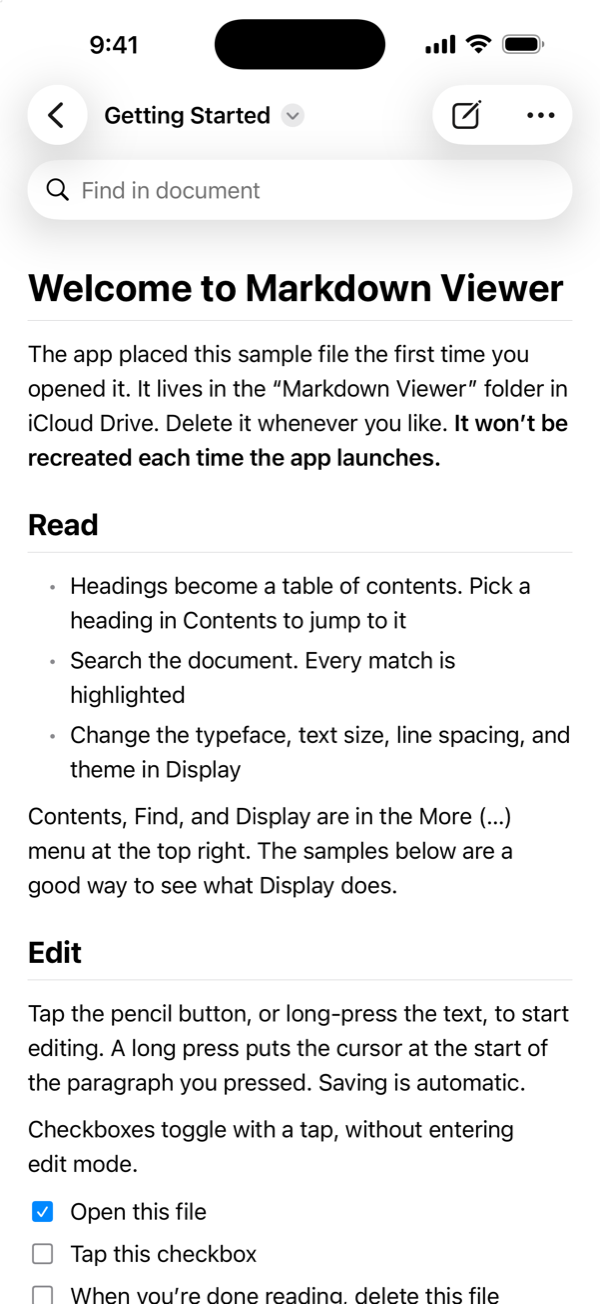
Task lists toggle on tap, without entering edit mode. The toggle rewrites exactly one
character in the source, turning [ ] into [x] and back.
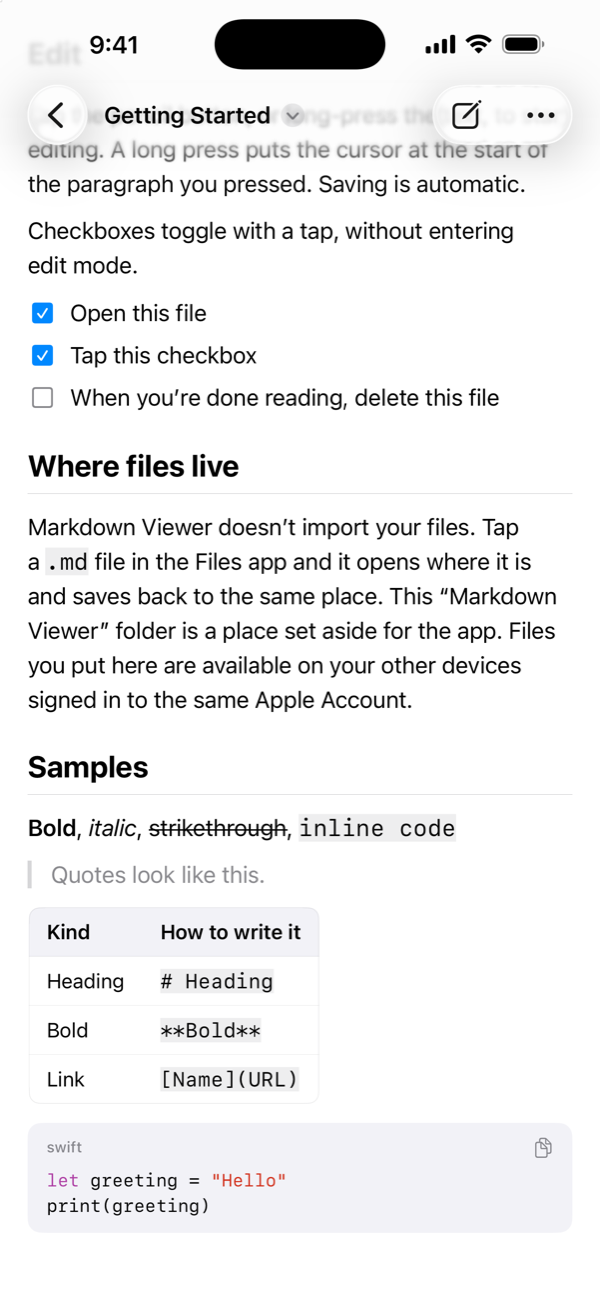
Tap the pencil, or long-press a paragraph to start editing at its beginning. What you edit is the plain Markdown.
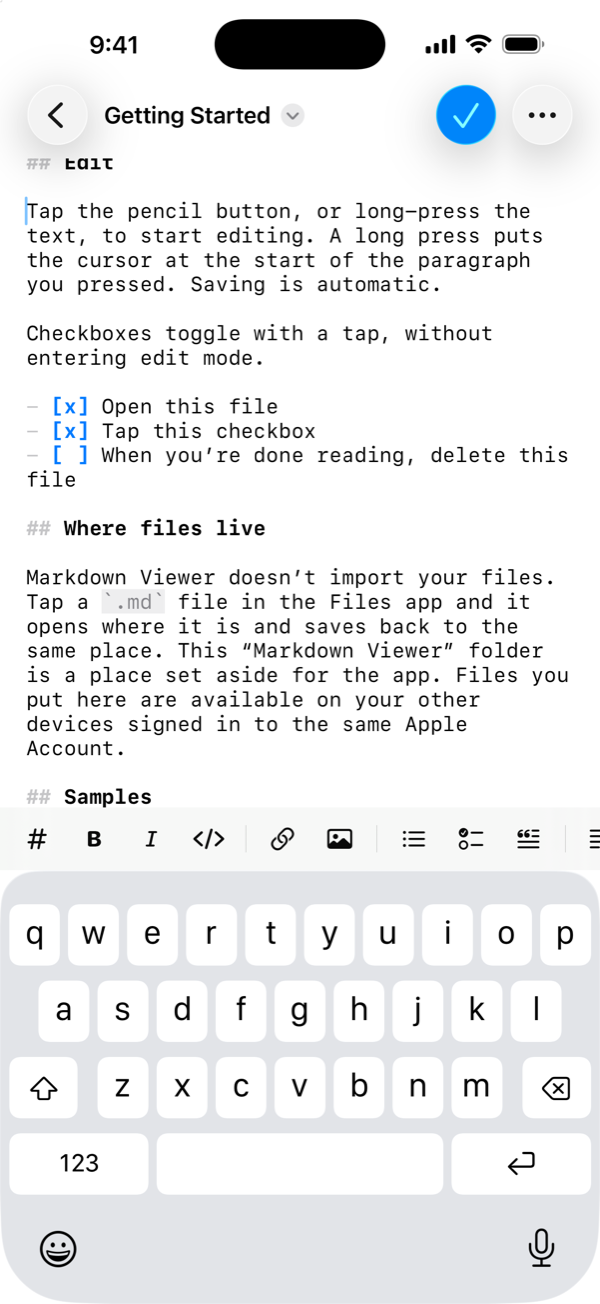
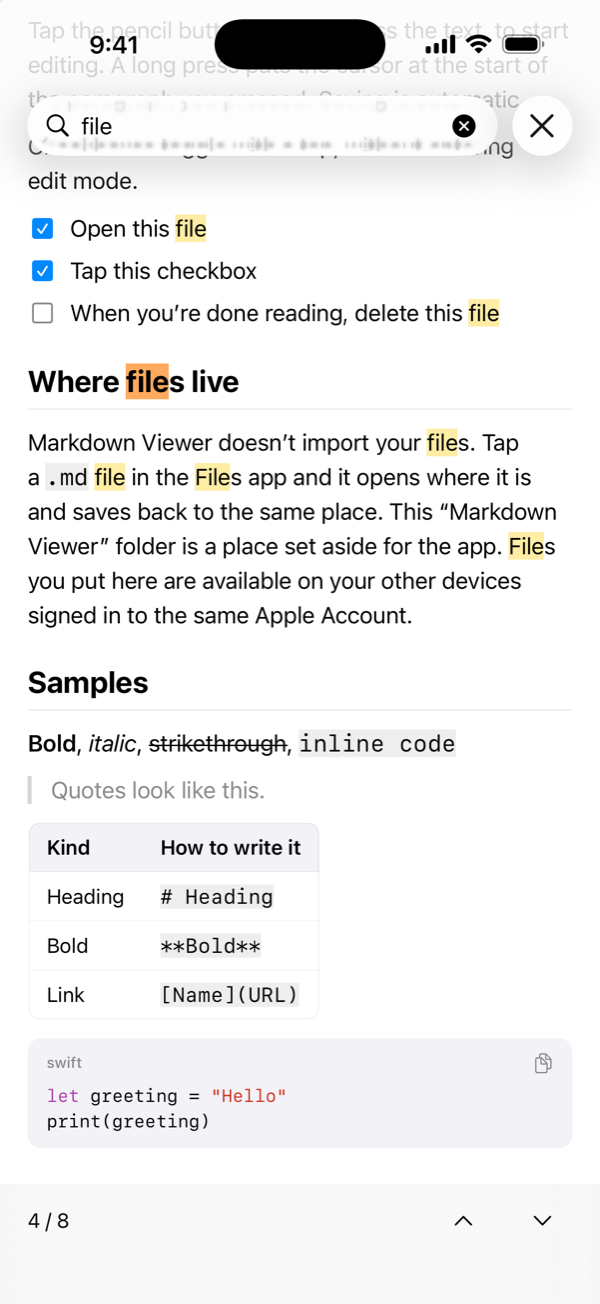
A table of contents is built from your headings; tap one to jump there. Find in document ignores case, character width, and Japanese voiced marks.
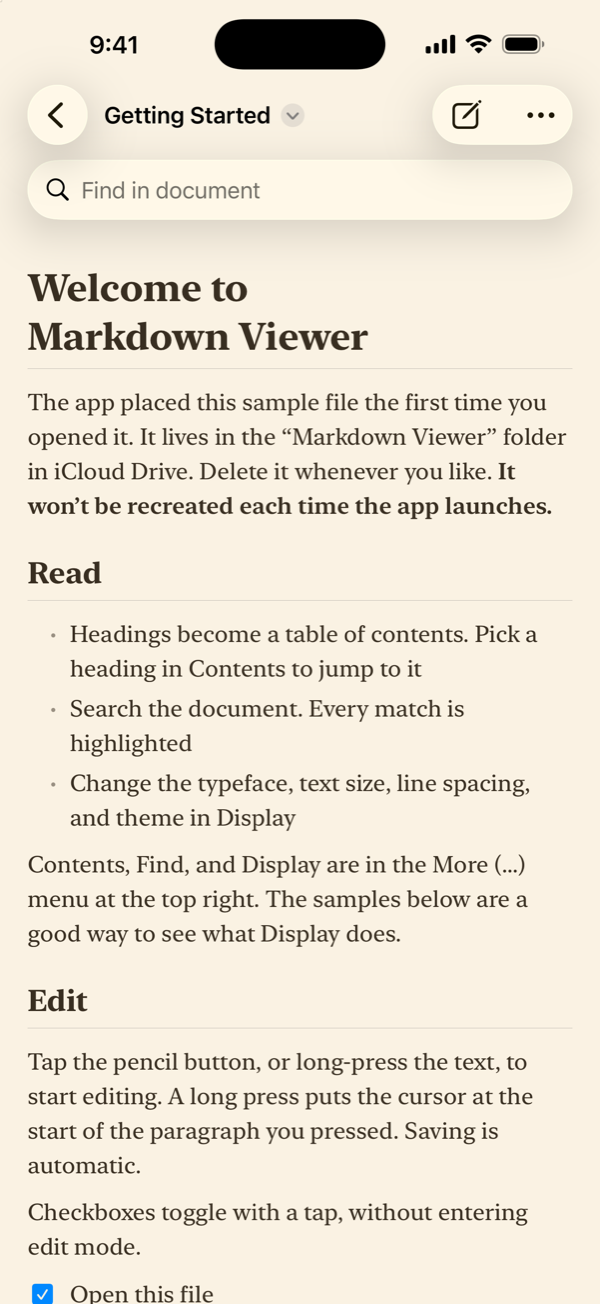
Serif or sans. Text size and line spacing are yours to set, applied on top of your system text size.
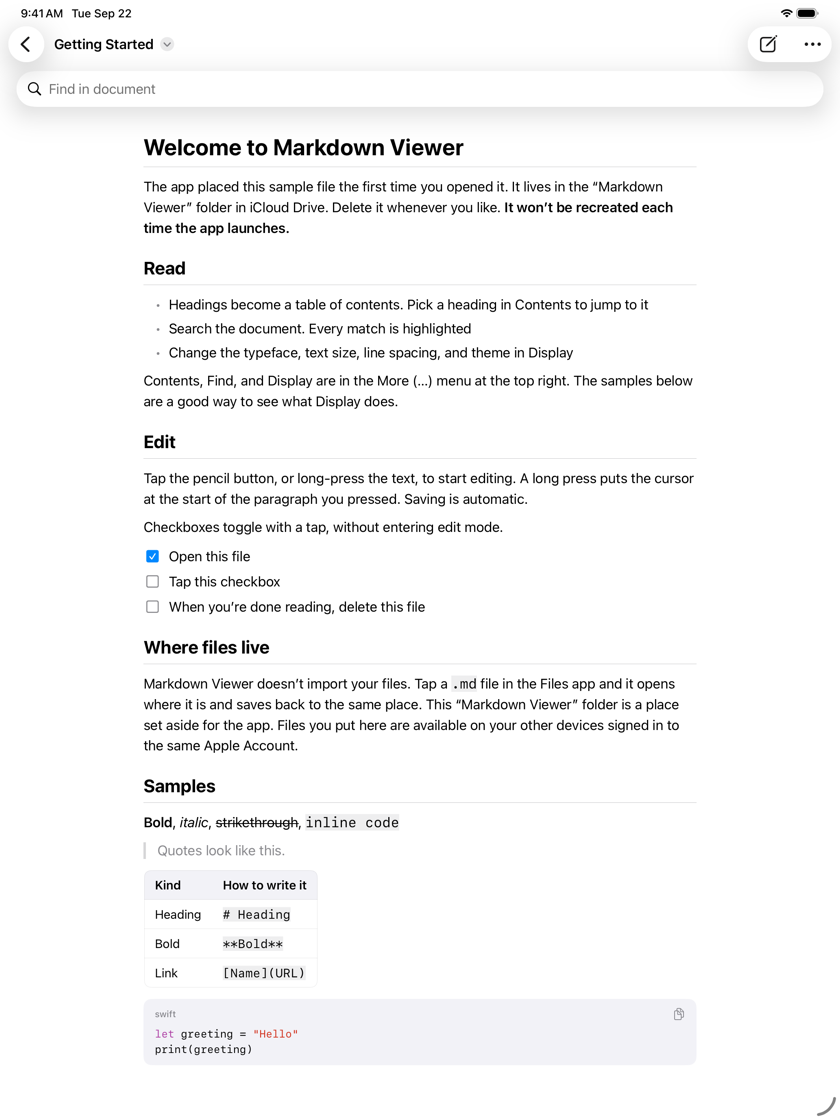
Open several documents at once in Stage Manager or Split View. On a wide screen, lines stop at a comfortable width instead of running edge to edge.
Before any feature, it was settled what the app must never do to your files.
Nothing is imported. The app opens a file where it lives, lets you change it, and hands it back.
Read a file and save it again, and every line you did not touch is byte-for-byte identical.
Parsing is done by Apple’s swift-markdown, built on cmark-gfm, GitHub’s own fork of the CommonMark reference parser.
If the same file is changed on another device or in another app at the same time, you pick which version to keep.
No account, no server, no analytics. The app goes online only to fetch an image a document points at, or to open a link you tap.
Nothing to sign up for. There is no server run by the developer.
Files are read and written where they live. No copy is made inside the app, and none is sent to the developer.
Only when a document points at an image by URL does the app fetch it, from the address written in the document. Never from the developer.
A link you tap opens in a Safari view inside the app. The app cannot see what the page contains.
Inserting an image goes through the system photo picker, so the app never asks to read your library. It receives only the photo you pick.
No analytics or advertising SDKs. The App Store privacy label declares that no data is collected.
For details, see the Privacy Policy.